Best Penny Drop Verification API for Fintech Companies
2026-02-18
Fintech
Back to Blogs
Fintech companies move money at scale. Loan disbursements, merchant settlements, refunds, and vendor payouts happen every minute. In this environment, even a small mistake in bank details can lead to failed transfers, customer Validation, and financial loss.
Wrong account numbers, mismatched names, and fraudulent bank details are common risks in digital payments. That is why a Penny Drop Verification API is no longer optional for fintech companies. It has become a core part of secure payout infrastructure.
This article explains how to choose the best Penny Drop Verification API for fintech companies and what features truly matter at enterprise scale.
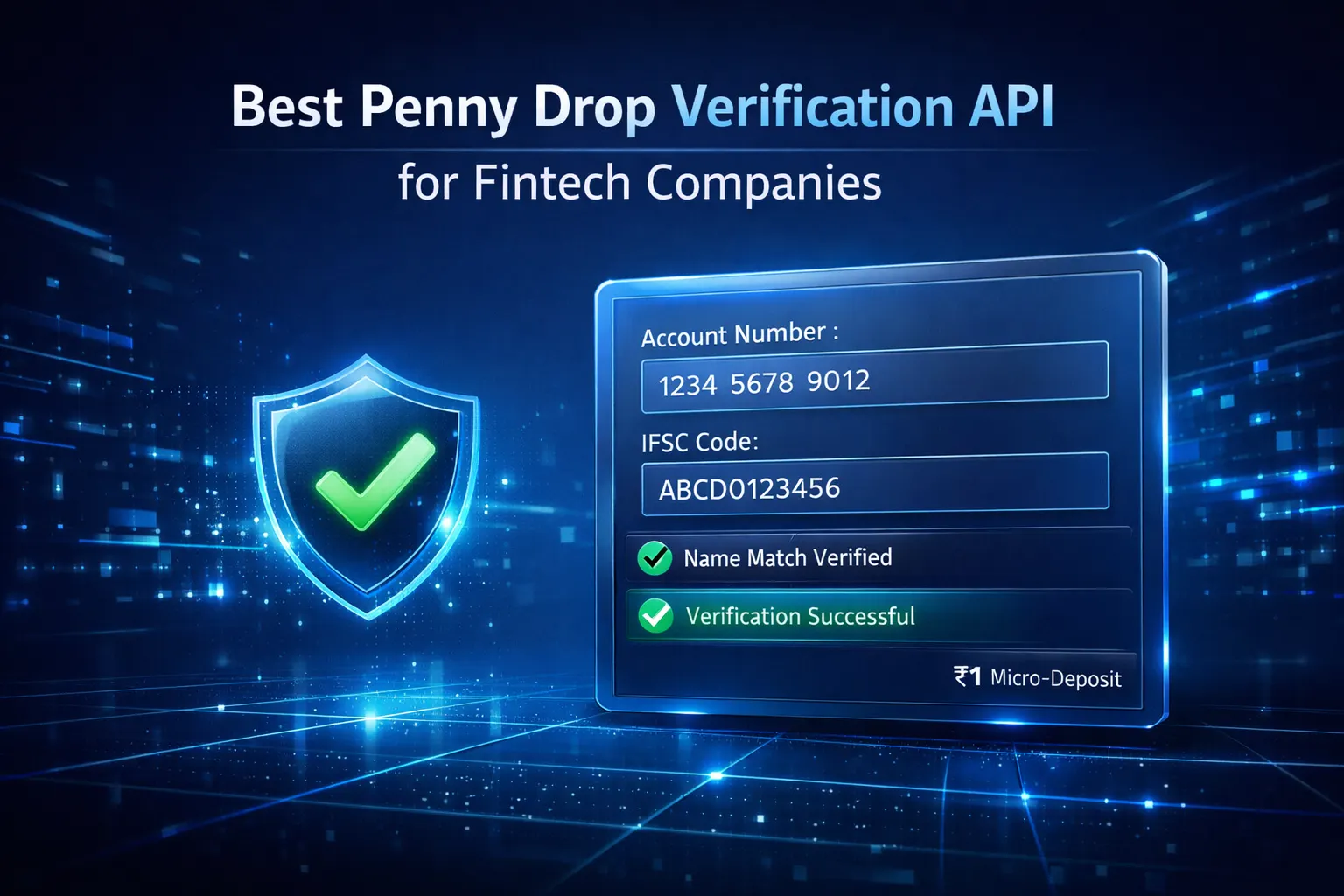
A Penny Drop Verification API is a method used to verify a beneficiary’s bank account before transferring large funds. It works by sending a small amount, usually ₹1, to the provided account through IMPS. The system then validates whether the submitted account information is consistent with the bank account details.
This process confirms whether the account number and IFSC code are valid. It also enables bank account validation by comparing submitted account information with the verification response.
In simple terms, it is a form of Instant Bank Account Verification. Instead of waiting for failed transfers, fintech platforms can validate accounts before sending actual payouts.
In India, the demand for Penny Drop API India solutions has grown rapidly because digital lending and real-time settlements have increased across sectors.
Fintech businesses deal with high transaction volumes. A single error can multiply across thousands of payouts. Here is where Real-Time Bank Account Verification becomes critical.
For example, digital lenders rely on a Loan Disbursement Verification API before crediting funds to borrowers. If a loan is disbursed to the wrong account, recovery becomes complex and costly. Penny drop verification ensures that funds reach the intended beneficiary.
Payment aggregators and marketplaces also depend on Fintech Payout Verification to validate merchant accounts before settlements. This prevents fake vendor registrations and payout fraud.
Refund systems also benefit from an Account Validation API, especially when processing bulk refunds. Validating accounts in advance reduces transaction failures and operational workload.
Without proper validation, fintech platforms risk:
A strong Bank Account Verification API addresses these risks before money leaves the system.
Not all solutions offer the same level of reliability. The best Penny Drop Verification API for fintech companies should meet enterprise-grade standards.
Secure payout systems depend on multiple layers of validation. A Penny Drop Verification API acts as the first line of defense.
When integrated into onboarding workflows, it ensures that only verified bank accounts are added to the system. This reduces internal risk.
For lenders, combining KYC checks with a Loan Disbursement Verification API ensures that both identity and bank account details are validated before credit approval.
For gig platforms and marketplaces, Fintech Payout Verification prevents fraudsters from registering fake accounts to divert payments.
It also improves operational efficiency. Failed transactions often lead to reversal charges and manual reconciliation. By enabling Instant Bank Account Verification, fintech companies reduce these hidden costs.
Over time, this builds a stronger verification framework. Audit trails from a Bank Account Verification API help demonstrate due diligence during guidelines reviews.
Many fintech platforms still rely on manual verification or post-failure corrections. This approach is risky.
Without a proper Real-Time Bank Account Verification process, businesses face higher transaction failure rates. Customer trust drops when payouts fail repeatedly.
Manual checks also slow down loan disbursements. In competitive lending markets, delays can push borrowers toward other platforms.
Fraud risk increases when bank details are not validated. A missing Secure Payout API layer creates gaps that attackers can exploit.
In short, skipping validation may save time initially, but it increases long-term operational and financial risk.
Selecting the right provider requires careful evaluation.
When these elements come together, fintech companies can build a secure and scalable payout infrastructure.
In today’s digital finance ecosystem, verifying bank accounts is not just a technical step. It is a risk control mechanism.
The best Penny Drop Verification API for fintech companies supports real-time validation, reduces fraud, and improves payout success rates. It acts as a foundation for secure lending, merchant settlements, and high-volume disbursements.
By integrating a reliable Account Validation API with strong Fintech Payout Verification capabilities, enterprises can prevent costly errors and strengthen Financial management.
As fintech platforms continue to scale, a robust Penny Drop API India solution will remain essential for building trust, ensuring Verification, and protecting every transaction.