How RC APIs Boost Fintech: Faster Loans, Lower Fraud
2025-08-23
Fintech
Back to Blogs
In today’s competitive fintech market, speed and accuracy decide who wins the customer. Products like vehicle-backed lending, fleet financing, BNPL programs for autos, and motor insurance all depend on verifying one critical factor: the vehicle’s registration details. Traditionally, this process was manual, slow, and prone to errors.
This is where Registration Certificate APIs change the game. By delivering real-time, structured vehicle registration information, these APIs reduce approval times from days to minutes. They help fintechs cut fraud, manage risk, and meet operational standards while giving customers a faster, smoother experience. For digital lenders and insurers, this means faster growth, lower losses, and stronger trust.
An RC API is a programmatic service that takes a vehicle identifier such as a registration number or VIN and returns structured vehicle registration information. Typically, this includes registration details, vehicle registration information, make and model, year of manufacture, and encumbrance or pledge status. Advanced APIs also provide insurance validity, fitness expiry, or even stolen/loss indicators.
Because the results are structured and machine-readable, they can be plugged directly into underwriting systems, decision engines, or verification dashboards, making the entire verification process faster and more reliable.
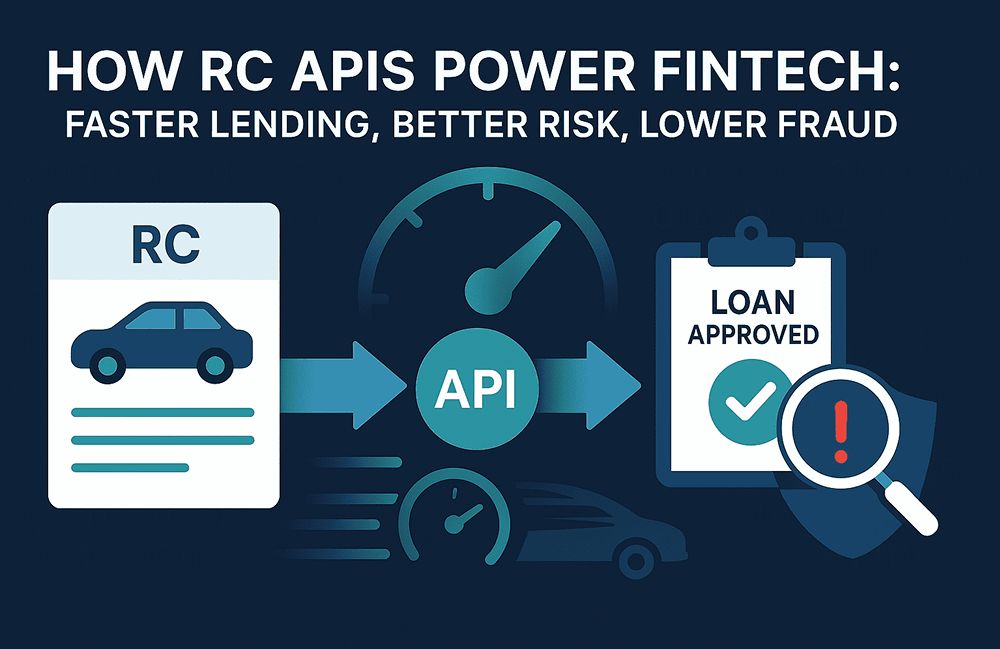
The workflow is simple. When a customer applies for a loan or insurance quote, their registration number is collected. The system calls the RC API, which normalizes the input, and returns structured JSON within second.
The fintech platform then applies its rules: straightforward cases are approved automatically, suspicious ones are flagged for review, and doubtful cases are routed for manual checks. Every API response comes with timestamps and request IDs, ensuring a complete and auditable trail.
The impact of RC APIs is measurable. Decision times drop from days to minutes, synthetic identities and duplicate RCs are flagged before they cause losses, and operational costs fall thanks to reduced paperwork. meeting standards becomes easier too, as APIs provide structured logs supervisory teams can trust.
Most importantly, customer experience improves. Borrowers get faster responses, partners see fewer disputes, and lenders build stronger relationships. In a market where reputation and trust are everything, these improvements can be a decisive advantage.
Not all RC APIs are equal. The best solutions provide fresh, complete coverage and include advanced checks such as confidence scores for registration verification matches, hypothecation details, and RC status updates. Smart fintechs adopt a tiered approach: high-confidence cases are approved instantly, mid-confidence cases may require supporting documents, and low-confidence cases are routed for manual review. This method ensures genuine customers are not rejected unnecessarily while maintaining strict risk control.
Integrating RC APIs is straightforward but requires planning. For real-time onboarding, synchronous queries are ideal, while batch queries work better for portfolio reviews. Platforms should cache short-term results, implement retry mechanisms, and map vendor errors into user-friendly messages.
Monitoring latency, review rates, and confidence scores provides valuable insight, while strong encryption and masking ensure verification with information protection laws. With these practices in place, RC APIs can be deployed securely and at scale.
Done well, RC verification isn’t just about standards, isn’t only about following guidelines it’s a growth driver:
In a market defined by speed, risk management, and customer trust, RC APIs deliver all three. For fintechs aiming to stay ahead, adopting RC APIs is not optional it’s essential.
👉 To learn more or explore integration, visit our contact us or email us at business@apimall.in.