How RC APIs Help NBFCs Lend Faster, Smarter, and Safer
2025-08-25
NBFC
Back to Blogs
For NBFCs, lending against vehicles powers everything from two-wheeler finance to large fleet loans. But traditional verification methods, manual document checks, manual verification calls, and physical visits create bottlenecks. They slow approvals, increase operational costs, and expose lenders to fraud.
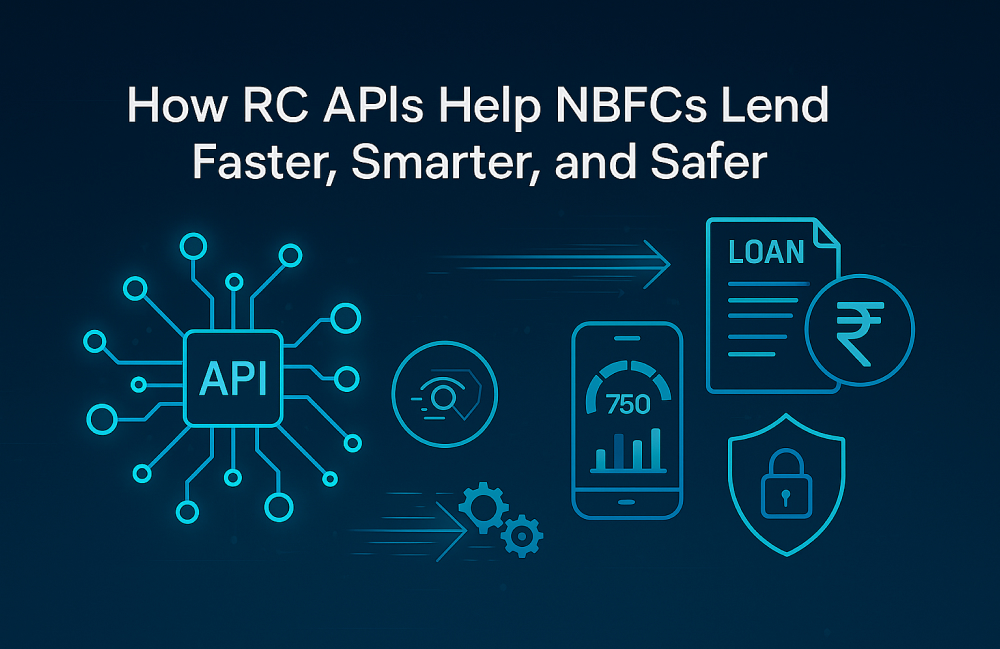
RC APIs (Registration Certificate APIs) solve this challenge by providing real-time, structured vehicle registration information directly into underwriting systems. Instead of waiting days for verification, NBFCs can confirm vehicle registration information, standards, and risk factors within seconds.
An RC API turns a vehicle registration number or VIN into a digital, trustworthy asset record. Within seconds, lenders can access details such as:
This structured information set eliminates ambiguity, reduces manual intervention, and accelerates loan approvals.
NBFCs operate in a competitive lending market where customer experience, risk control, and standards define success. RC APIs bring multiple advantages:
Equally important, RC APIs leave behind a digital audit trail with timestamped logs giving monitoring teams and partners confidence in standards and transparency.
NBFCs can adopt RC APIs in different ways depending on their scale and workflows. Synchronous checks work best for instant decisions at dealer checkout or app-based onboarding. Asynchronous or batch checks allow lenders to refresh large portfolios overnight, while hybrid models combine both supporting real-time verification at disbursal plus scheduled re-checks for ongoing monitoring.
To optimize costs and reliability, NBFCs should cache short-term results, set retry logic with exponential backoff, and define fallback flows where low-confidence results are escalated for manual review. Using a normalized schema across vendors ensures easier downstream integration.
Fraud in vehicle-backed lending is common, and APIs help detect it before loans are disbursed. Common red flags include mismatches between applicant details and vehicle registration information, duplicate registrations across loan portfolios, hypothecation flags showing vehicles already pledged, and rapid registration record changes that may signal asset stripping.
By surfacing these risks in real time, APIs protect NBFCs from costly defaults and legal disputes.
NBFCs must balance innovation with required standards. APIs make this easier by supporting privacy-first practices. Lenders can fetch only the required information fields, encrypt sensitive information in transit and at rest, and set retention policies aligned with regulatory norms. Storing timestamped responses also ensures that every decision can be defended during audits or disputes.
RC APIs come with flexible pricing models. Smaller NBFCs may prefer pay-per-call options for low volumes, while larger lenders often adopt subscription or credit-based models for predictable costs. A hybrid approach combining a base subscription with discounted per-call rates can optimize expenses.
Costs can be further reduced through caching, batch checks, and field-level requests. The ROI is clear: faster approvals, higher conversions, fewer charge-offs, and reduced staff hours translate into measurable savings.
To measure impact, NBFCs should monitor decision turnaround time, conversion rates, fraud detection rates, and charge-off reductions. Operational efficiency calculated as manual hours saved is another vital KPI. These metrics not only track performance but also strengthen internal reporting and investor confidence.
Consider a regional NBFC specializing in two-wheeler loans. Before adopting RC APIs, its manual verification took 48–72 hours, with nearly 30% of customers dropping off during checkout. A large team was needed to process verifications.
After integrating RC APIs, loan approvals dropped to under 20 minutes. Conversion rates improved by 30%, fraud losses reduced by 25%, and verification staff workload fell by 40%. The results were not just operational but strategically higher customer satisfaction and stronger financial outcomes.
In a market where speed, accuracy, and standards define success, RC APIs are not optional; they are essential for NBFCs that want to grow faster, smarter, and safer.
👉 To learn more or explore integration, visit our contact us or email us at business@apimall.in.