Why Every Law Firm Needs a Challan API
2025-09-02
Legal
Back to Blogs
The legal world thrives on precision, accuracy, and speed, yet attorneys and paralegals often find themselves bogged down by outdated processes. Tasks such as verifying challans frequently involve dealing with scanned PDFs, paper trails, and repeated calls to multiple offices. These manual methods not only slow down case progress but also increase the chances of error.
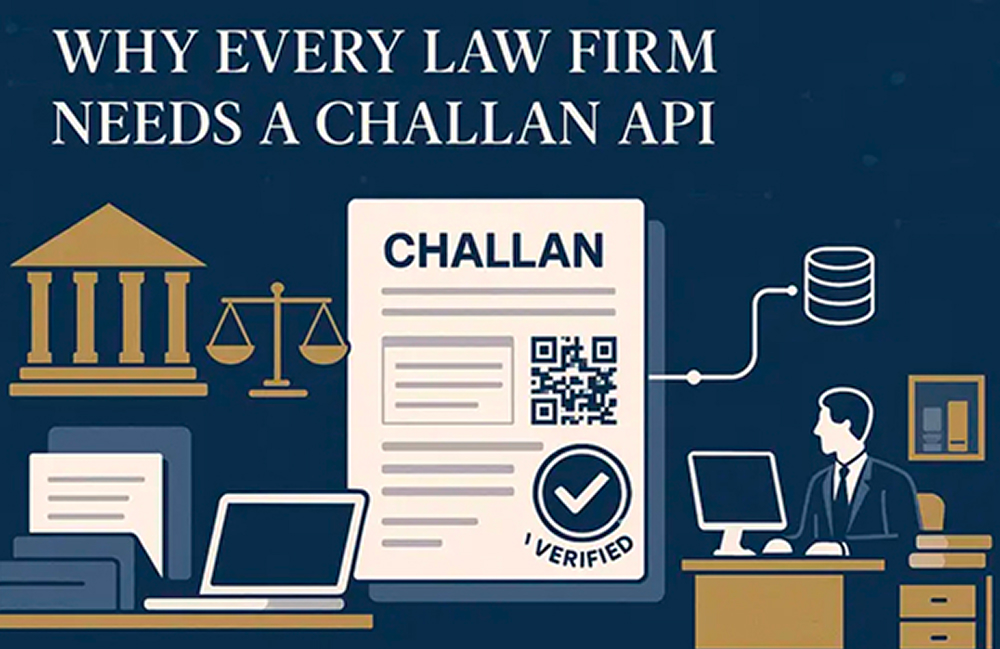
A Challan API is transforming this reality. With a single secure request, legal teams can access verified, real-time challan Information that can be cited in court, stored in digital records, and automated across multiple matters. For litigation, insurance defense, corporate guidelines, or asset recovery, this technology converts raw, fragmented Information into reliable evidence that moves cases forward.
At its core, a Challan API is a digital connector between your case management systems and live challan information tied to vehicles or drivers. Instead of relying on clerks or assistants to manually verify details, one API call instantly returns structured and timestamped Information that is immediately ready for exhibits, filings, and internal workflows.
The scope of its functions is extensive. It enables instant challan lookups, provides updates on payment and current status, and categorizes offences by sections and fines. In addition, it supplies crucial details such as the date and location of the offence, issuing verification source, and official references, ensuring that lawyers have access to clear, verifiable, and court-ready Information.
The importance of a Challan API in the legal sector cannot be overstated. In case preparation and due diligence, it helps lawyers build stronger pleadings, affidavits, and petitions by grounding them in verified facts rather than outdated attachments. This precision enhances credibility before judges and regulators.
During guideline-driven processes such as mergers, acquisitions, or financing deals, firms can use the API to confirm that vehicle assets are clean, lien-free, and legally usable, minimizing post-transaction risks. Litigation, too, benefits enormously, as days of follow-up work can now be replaced with automated retrieval that delivers results in minutes. This means faster filings, quicker hearings, and fewer delays caused by missing documents.
The adoption of a Challan API brings measurable improvements across every level of a law firm. Accuracy is one of the greatest benefits, as it reduces dependence on photocopies, mismatched reports, or incomplete Information that can weaken a case. Time savings are equally significant; paralegals can reclaim hours for more valuable case work, while partners and senior attorneys can focus on developing strategy rather than chasing administrative details.
Fraud detection also becomes far more efficient, as the API highlights unpaid challans, duplicate entries, or suspicious patterns that may otherwise go unnoticed. Finally, digital documentation strengthens the firm’s audit trail. With every API result stored alongside timestamps and query IDs, firms gain defensible records that stand up to scrutiny during audits or court proceedings.
The potential use cases for a Challan API in legal practice are broad and practical:
Integrating a Challan API into daily workflows is straightforward. At the intake stage, vehicle or driver details are captured in the firm’s document or case management system. With those details in hand, the API can be triggered—either manually through a click or automatically as part of a rule-based workflow.
Results are delivered in structured formats such as JSON or PDF, complete with reference IDs and freshness timestamps that confirm reliability. Lawyers can then use this Information to auto-populate case notes, generate exhibits, or set reminders for follow-up tasks.
For ongoing matters, especially in areas such as corporate fleet management or long-running litigation, firms can schedule periodic checks to ensure they always have the most up-to-date information.
Beyond efficiency, a Challan API provides technical advantages that align with modern law firm operations. Integration is simple, as most APIs work with existing case management tools through REST/JSON protocols. Real-time Information minimizes the risk of evidence becoming stale, which often necessitates rework.
Security is built into the system, with encrypted transport, role-based access, and event logs to protect sensitive client information. Scalability ensures that firms can handle surges in workload, whether during discovery phases or when multiple matters reach critical stages simultaneously.
Together, these features make the API a robust tool for firms seeking both reliability and growth.
Operating without a Challan API leaves firms vulnerable to inefficiencies and risks. Inconsistent sources lead to conflicting attachments, slowing down strategy and creating confusion. manual record entry introduces higher risks of error, with transcription mistakes potentially creeping into important filings.
Moreover, valuable staff time is wasted on repetitive administrative tasks, leaving less capacity for substantive legal work. This not only reduces productivity but also increases costs and delays for clients.
Not all APIs are created equal, which is why selecting the right provider is crucial. A good provider should offer wide coverage across geographies, frequent Information updates, and clear provenance to confirm authenticity.
Reliable uptime backed by service-level agreements ensures availability when it matters most. Documentation and SDKs should be clear, offering sandbox environments and quick-start guides for faster adoption.
security and operational standards must also be robust, including encryption, audit logs, IP allow-listing, and support for Information protection agreements. Finally, pricing should be flexible and aligned with the firm’s size and usage needs, ensuring both affordability and strong return on investment.
Successful adoption requires more than just plugging in the technology it demands thoughtful implementation. Training staff is essential, with playbooks or quick guides helping paralegals and assistants adapt quickly.
Automating templates to insert verified fields into notices, petitions, or annexures streamlines workflows. Confidence rules can be applied so that low-confidence results are flagged for manual review, preserving accuracy without slowing processes.
Information hygiene practices, such as logging query IDs, storing timestamps, and redacting sensitive information, further improve guideline adherence and defensibility.
The impact of Challan APIs is already being seen in practice. Litigation teams using the technology have reported reducing evidence preparation time by nearly 40%, enabling faster filings and better calendar control.
Insurance legal desks have detected up to 15% more questionable claims, which strengthens negotiation positions and saves clients significant amounts. Corporate counsel managing large fleets have automated pre-renewal standards check, leading to fewer surprises and cleaner certifications.
These examples highlight not only efficiency gains but also improved outcomes for clients.
Despite the clear benefits, some misconceptions hold firms back. Many believe APIs are too complex to implement, but modern APIs are plug-and-play with user-friendly documentation.
Others worry about security, when in reality, properly implemented APIs with encryption and audit logs are safer than traditional email or paper-based processes. Another common myth is that APIs are only for large firms. In fact, smaller practices often benefit the most, as automation frees up limited resources and ensures consistency in their work.
A Challan API is no longer an optional tool but a necessity for forward-looking law firms. By introducing speed, accuracy, and accountability into processes that were once manual and error-prone, it transforms the way cases are prepared and managed.
Firms that integrate this technology today will enjoy faster outcomes, lower risk, and more satisfied clients, while also positioning themselves as innovators in a competitive legal landscape. In a profession where every second and every fact matters, adopting a Challan API is one of the smartest steps a firm can take to stay ahead of the curve.
👉 To learn more or explore integration, visit our contact us or email us at business@apimall.in.